Case study— 2026
Deverse
Own project
- Role
- Product design & full-stack engineering
- Type
- SaaS Product
- Year
- 2026
- Status
- In progress
Stack
- React
- TypeScript
- NestJS
- Prisma
- PostgreSQL
- TanStack Query
Deverse is a multi-tenant platform built to give dance schools one place to manage their day-to-day operations and their online presence.
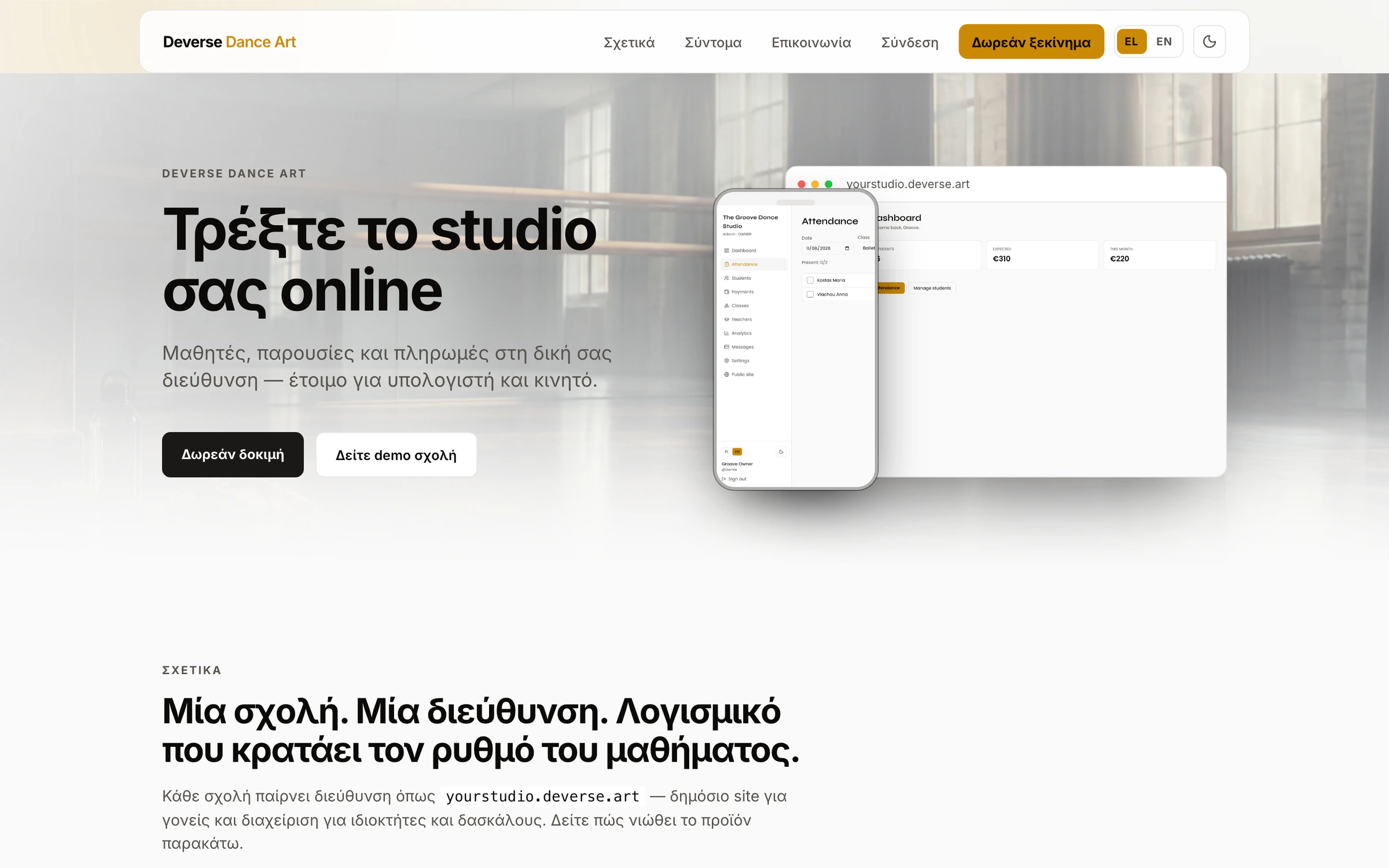
Each school gets its own branded website and subdomain, alongside a private workspace for managing students, attendance, monthly payments, teachers and the information published on its public site. Role-based access gives owners, secretaries and teachers the tools they need without exposing parts of the system they shouldn’t manage.
The goal is to replace the mix of spreadsheets, paper attendance sheets and disconnected tools that schools often rely on with a single system built around how a dance school actually operates. Owners get a clear view of the school, staff can handle everyday administrative work, and the same platform keeps the public-facing website up to date.
Deverse is built as a multi-tenant SaaS, with every school operating in an isolated tenant environment while sharing the same application infrastructure. Tenant boundaries are enforced server-side and covered by automated tests, authentication uses short-lived JWTs with rotating refresh tokens, and sensitive financial data is encrypted at rest using AES-256-GCM.
Technical challenges & decisions
Multi-tenancy is the constraint the rest of the system is built around. Every school-scoped row belongs to one school, and both the public site and the admin resolve that school from its slug. The API enforces the boundary, so one school cannot read another's students, payments or attendance.
Owners, secretaries and teachers share one login, scoped to a school. Access tokens are short-lived. Refresh tokens are stored as hashes and rotated. A guard in front of school routes stops an expired trial from continuing to use the admin.
A payment is unique per student, month and year. The fee is encrypted at rest with AES-256-GCM. When a month is marked paid, the expected amount is snapshotted, so a later price change does not rewrite that month. Months outside a student's billing window, and months the school is closed, stay out of the paid or unpaid status.
Attendance is one record for a calendar day: present, absent, late or excused, including a make-up visit that belongs to another class. Teachers see the classes they teach. Owners see the school.
The public site is a React application and the API is NestJS on PostgreSQL. nginx serves the site and proxies the API. Continuous integration runs lint, tests and the production builds. Putting a release on the server is a separate step.
Next project
CoupleGoal